Data Infrastructure: The Trail Behind the Tonne

Anwita
Sep 3, 2026

Data Infrastructure: The Trail Behind the Tonne
Article 2 of 3
A pyrolysis plant makes two things at once: char, and a record of how that char came to be. The first piece in this series looked at the plant itself, the feedstock networks that feed it, the reactor that does the work, and the discipline of running it consistently, batch after batch. This piece looks at the second thing the plant produces: the system that tracks a tonne of rice husk from the moment it arrives on a truck to the moment its carbon is sitting in a field, and turns that tracking into a number.
The system we are describing
Here is the plant this system runs on: a 2-tonne-per-hour indirectly heated rotary pyrolysis kiln, running rice husk at roughly 40 to 50 tonnes of input a day. Feedstock arrives on a weighbridge, is logged by origin and moisture, and moves through pyrolysis, cooling, and dispatch as a tracked batch. Every tonne that enters is accounted for, and every tonne that leaves is accounted for. The rest of this piece describes how that accounting works, step by step, from the gate to the field.
The diagram below is the spine of this piece: the physical path a single tonne takes, from the truck that brings it in, to the soil where its carbon is stored. Every data point below attaches to a step on this path, in order: what goes in, what happens inside, and what goes out.
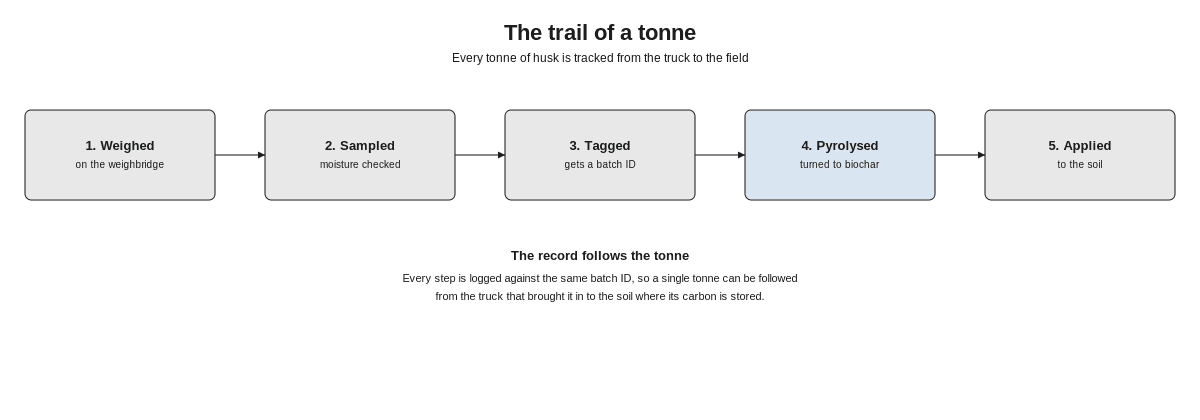
1. Mass and energy balance: what goes in must come out
The starting discipline is a mass and energy balance: for the plant as a whole, what goes in must come out, fully accounted for. Every tonne of feedstock in, and every tonne of product, by-product, and loss out, is tracked against the same record.
Mass. Take one truck. A flatbed loaded with rice husk arrives from a mill nearby, where the husk has sat in a shed since the last milling run. It crosses the weighbridge, gross weight first, tare weight on the way out, and the difference becomes the first hard number on the load's record. The load is tied to the specific mill it came from, since storage conditions there show up later in the moisture reading and drying time. Once weight, sample, and origin are logged, the load gets a batch ID, the one piece of information that travels with this husk through drying, the reactor, cooling, and out the gate weeks later as bagged char, with every later measurement filed under that same ID.
Moisture. While the weight is being logged, a QA team member pulls a sample from several spots on the load, not just the top, since moisture isn't even through a truckload that's been rained on and dried more than once. The reading comes back within minutes and matters immediately: it sets how long this husk needs to dry, how much can be fed in the coming shifts, and roughly what yield to expect. Moisture drives most of what happens downstream: wet husk takes longer to dry, eats into throughput, and if it's underdried it drags reactor temperature down just when the chemistry needs it stable. The chart below shows moisture readings at intake across a production run. The variation is normal, husk arrives at different moisture levels depending on mill, season, and storage, but measuring it batch by batch lets the plant adjust drying and feed rate before the material reaches the reactor.
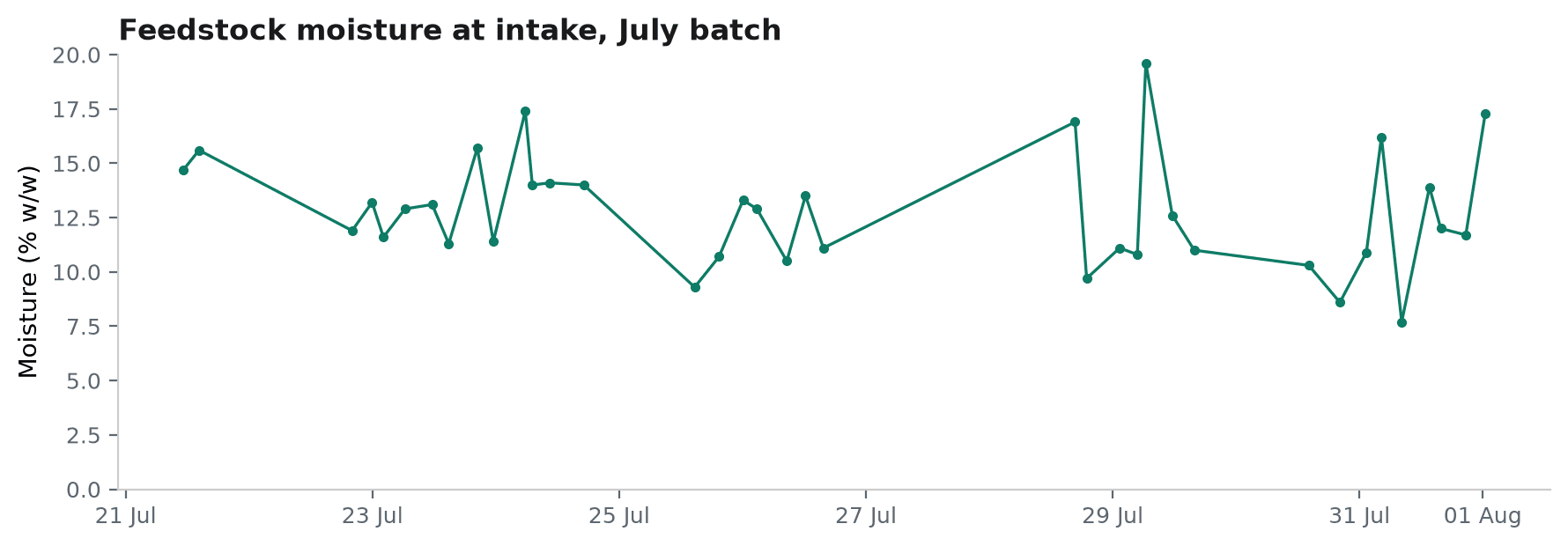
Figure 2. Feedstock moisture readings logged at the weighbridge for each incoming load.
The weighbridge total is reconciled against the feed-conveyor and char-out totals, and a batch's numbers stay provisional until mass in matches mass out. A discrepancy gets investigated rather than written off: someone traces where the missing weight went, whether moisture lost in drying, dust, spillage, or a measurement error, before the batch is considered settled.
Energy. Energy is read through utility and on-site solar meters and reconciled against the batch record for the period, rather than logged live per batch. That gives the plant an energy balance alongside the mass balance, showing how efficiently it's running and feeding into the net carbon benefit of the operation, since a cleaner power mix means a cleaner net-removal number.
2. Continuous monitoring inside the pyrolyzer
Once the husk from that truck has dried and its turn comes up in the feed queue, it goes into the reactor, where the actual chemistry happens. Biochar's permanence rests on that chemistry: hitting the temperature and dwell time needed to capture carbon durably, so what comes out is stable enough to stay in the ground for a very long time rather than breaking back down.
These three readings only mean anything together. Residence time, how long the husk sits in the hot zone, is set by kiln rotation speed and feed rate, held in range deliberately rather than left to drift. Temperature decides whether that time is doing anything: the operating band that reliably produces durable char here sits around 500 to 550°C, and residence time only counts toward permanence if it's spent inside that band. Pressure checks whether the other two can be trusted at all, confirming the reactor is behaving as designed, no blockage, no venting problem, so that the temperature and residence time being logged reflect what's actually happening inside. On their own, the three are just readings. Together, they say whether a batch went through the chemistry it needed to.
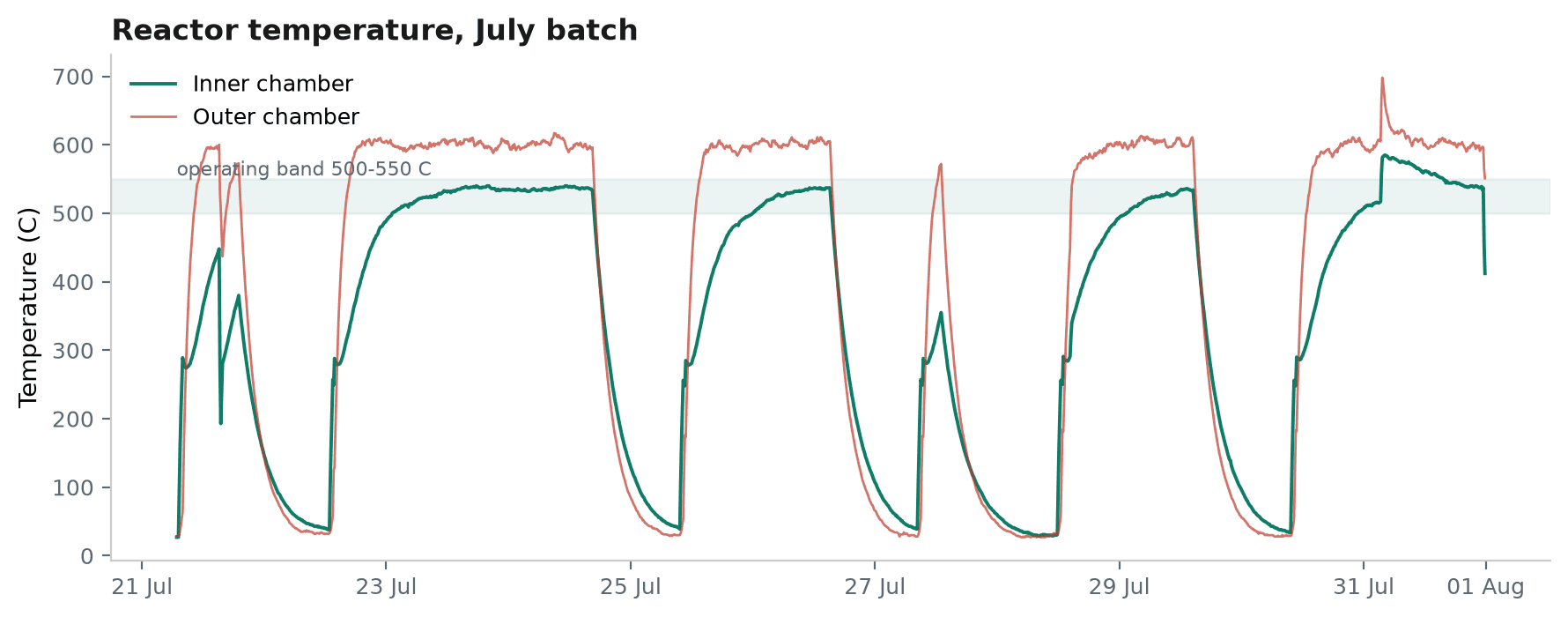
Figure 3. Reactor temperature over a July batch, plotted against the 500-550°C operating band.
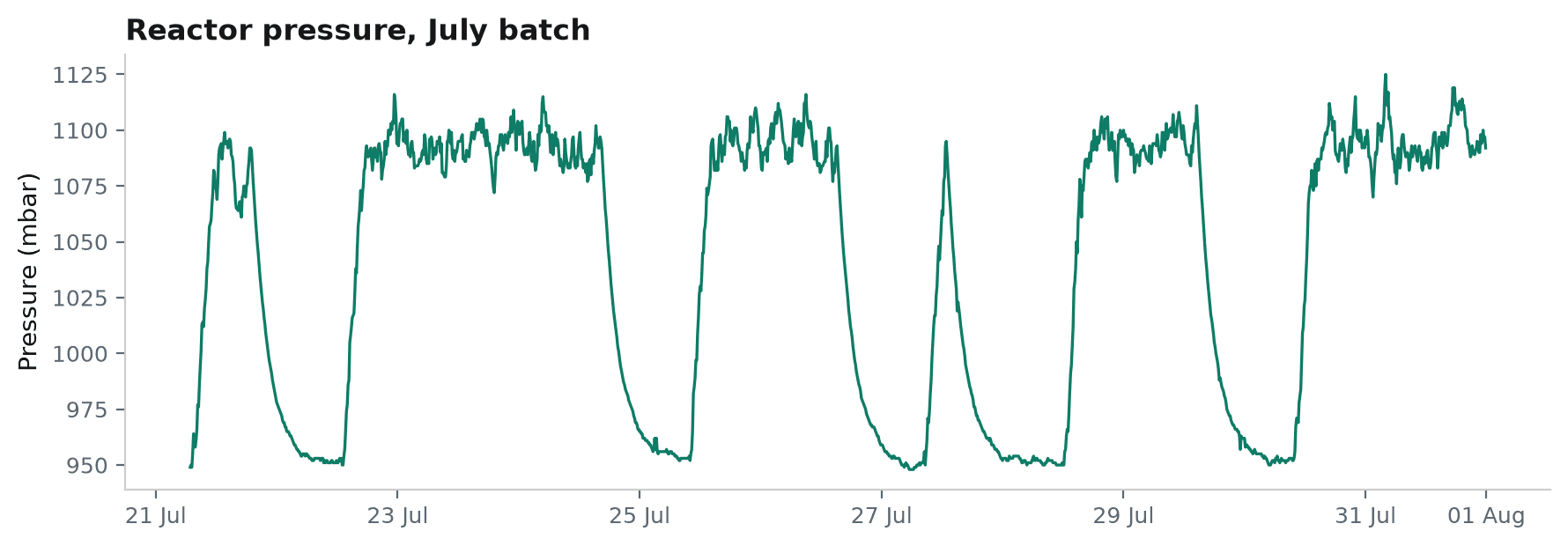
Figure 4. Reactor pressure over the same batch, confirming the reactor stayed inside its design envelope.
This is also why continuous logging matters for safety, not just for the record. A reading checked once a shift can miss a problem until it's already a problem; a reading logged every few seconds means a pressure rise or a temperature drift shows up within minutes, while there's still time to act. That's what lets an operator, or the system itself, cut the feed or adjust the run before a small deviation becomes an accident.
Any deviation outside the temperature envelope is timestamped automatically, which is what lets a batch get flagged the moment it happens rather than later. A batch that ran outside the band overnight, when nobody was watching a screen, still gets caught, because the log doesn't need a person staring at it in real time.
3. The chain of custody, from bag to soil
The record doesn't stop at the reactor. It has to survive the handoff from production to application: cooling, bagging, dispatch, and delivery, each its own step with its own data attached.
Cooling is itself a monitored step: char has to drop to a safe, stable temperature before bagging, and that cooldown is logged against the batch, both a safety matter and a record-keeping one. The batch from that truck sits here, still carrying its original ID, until it's cool enough to handle. From there, in order: it's bagged and tagged with that same ID; every dispatch is linked to a buyer, a contract, and a delivery location; and delivery is documented with geotagged photos, farmer sign-off, and delivery notes that tie the tonne to a place, bags of char spread across a field, with a photograph and a signature to show it.
No handoff depends on memory or reconstruction. The batch ID carries the record forward, so a single tonne can be traced backward through delivery, dispatch, bagging, cooling, the reactor run, and all the way to the truckload of husk that pulled onto the weighbridge weeks earlier.
Quality is confirmed by a lab assay on the actual batch, not a number carried over from the last one. Fixed carbon content and permanence indicators are measured directly; by-products, bio-oil and syngas, are allocated by a predefined methodology. The credit formula, credits per tonne of biochar equals carbon content times the permanent carbon fraction times 44 over 12, is applied the same way to every batch; what changes is the assay behind it. The assay and the batch record together either confirm a batch is good to sell or catch it before it goes out the door.
From operating record to bankable asset
Put all of this together and what you have is a plant that can say, for any bag of char it ships, exactly which truck the husk came from, how wet it was, how long it sat in the reactor, what temperature it saw, when it cooled, and where it ended up. Running well is necessary, but it's the record that turns a tonne of char into a defined, countable unit, one that can be priced, credited, and sold on its own terms rather than as part of an undifferentiated batch of "output."
Each step in that one truck's journey, weighbridge to field, exists because it's the point where something about that tonne got fixed and written down. String them together and you get the full life of a tonne, gate to field, with nothing left to reconstruct after the fact. The physical plant from the last piece and the data system in this one are two halves of the same operation. One produces the tonne. The other describes it, completely enough that the description can stand in for the tonne itself in any conversation about what was actually made.
Next up: Built for the Market

